

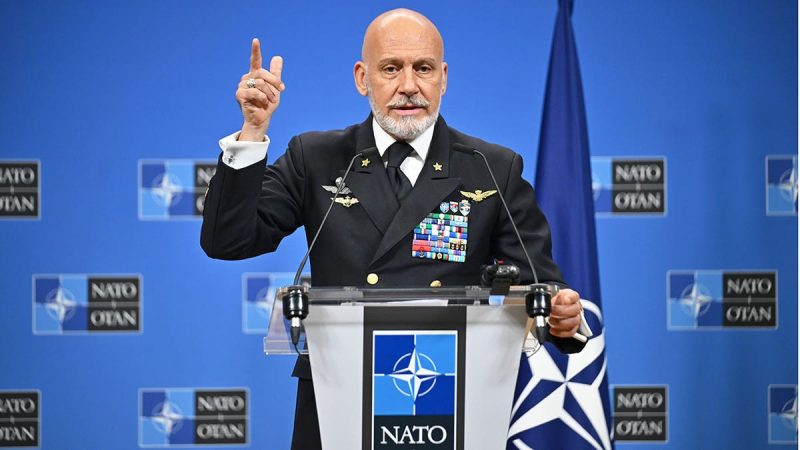
Tensions between NATO and Russia sharpened Monday after the alliance’s top military commander said member states are considering whether they must become ‘more aggressive’ in confronting Moscow’s hybrid threat campaign.
Admiral Giuseppe Cavo Dragone, chairman of NATO’s military committee, told the Financial Times the alliance is evaluating if it should be ‘proactive instead of reactive,’ including the possibility of ‘preemptive’ cyber or sabotage operations.
Dragone said such actions could still fall under defensive doctrine, saying, ‘It is further away from our normal way of thinking or behavior.’
Dragone pointed to the Baltic Sentry mission, launched this year to counter Russian-linked sabotage at sea, saying that ‘from the beginning of Baltic Sentry, nothing has happened. So this means that this deterrence is working.’
He added: ‘Being more aggressive compared with the aggressivity of our counterpart could be an option, but Dragone also admitted that NATO and its members had much more limits than our counterpart because of ethics, because of law, because of jurisdiction. It is an issue. I don’t want to say it’s a loser position, but it is a harder position than our counterpart’s.’
Moscow immediately pushed back. Russian Foreign Ministry spokesperson Maria Zakharova called Dragone’s comments ‘an extremely irresponsible step’ and accused NATO of signaling it is willing ‘to move toward escalation,’ according to Russian state media.
Carrie Filipetti, executive director of the Vandenberg Coalition and a former senior State Department and official at the U.S. mission to the United Nations, told Fox News Digital that, ‘Given Russia’s unilateral invasion of Ukraine in 2022, the idea that Russia is warning about NATO being irresponsible is laughable. Putin has been given numerous opportunities to end the war peacefully and has refused them all because of his own expansionist goals. NATO is simply reacting to his aggression.’
‘Regarding U.S. involvement,’ she explained, ‘Article 5 merely states that an attack on one is an attack on all. NATO adopting a more assertive position does not obligate the U.S. to do the same. We are only required to take ‘such action as [we] deem necessary’ – and that, only in the case of an attack on a NATO state.’
General Bruce Carlson, U.S. Air Force (ret.) and former director of the National Reconnaissance Office, told Fox News Digital, ‘Let’s not forget it’s Russia who is conducting preemptive military action in Europe with the sole intention of invading and occupying another sovereign nation’s territory by force.’
Carlson added, ‘Putin only understands one thing and that’s power. No one has strengthened NATO more than President Trump, and it is critical that we use every lever possible to push Russia to the negotiating table to achieve a lasting and sustainable peace deal that protects Ukraine’s sovereignty and defends U.S. national security interests.’
The warnings come amid a steady drumbeat of Russian-linked activity that NATO officials say falls under hybrid warfare. The alliance says it faces daily cyberattacks that can be traced to Moscow, alongside information operations, migration pressure, and repeated targeting of critical infrastructure.
A series of sabotage incidents in late 2024 triggered a major NATO review. Several undersea data cables and a key power link were damaged that November and December, including on Dec. 25. Prosecutors in Finland accused the crew of a Cook Islands–flagged tanker of dragging an anchor for more than 50 miles and severing infrastructure, though a Finnish court later dismissed the case, ruling national law did not apply.
More recently, roughly 20 drones crossed into NATO member Poland in September, prompting Warsaw to trigger Article 4 consultations. Polish Prime Minister Donald Tusk said at the time it was ‘the closest we have been to open conflict since World War II,’ while Moscow denied targeting Polish territory.